A lot has happened since my last post, and I want to document all of it because honestly, the pre-departure experience has been its own journey. Between a group retreat, a full round of peer presentations, and a countdown that is suddenly very real, I feel like a completely different version of myself than the one who first signed up for this trip.
The Climbing Tower
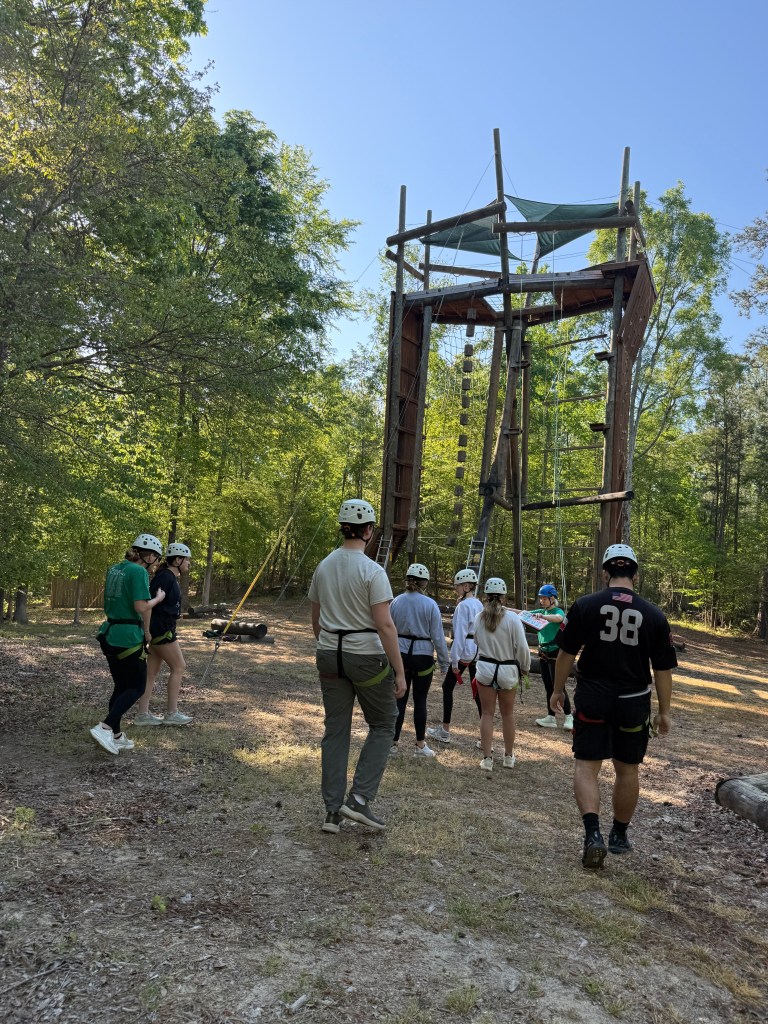
For our group retreat at Lake Laurel, one of our team bonding activities was a climbing tower. When I first saw it, I was immediately intimidated. I am scared of heights, so standing at the base of it and looking up was not exactly a feel-good moment for me.
I watched my group tackle the different courses first. Seeing people I had only just started getting to know cheer each other on, celebrate each other’s wins, and show up for each other in this small but real way made something shift in me. So I decided to try one of the walls. I did not make it to the top and that is okay because honestly, the fact that I even started felt like a win. The support I felt from the group gave me the courage to try something that genuinely scared me and that is not a small thing.
What I took away from that experience is bigger than a climbing wall. I learned that hard things are easier with the right people around you. I learned that trying and not finishing is still something worth celebrating. And I learned that this group is genuinely uplifting and supportive in a way that I think is going to carry us a long way over the next two weeks in Peru. I cannot wait to travel with them!
What I Learned from My Peers
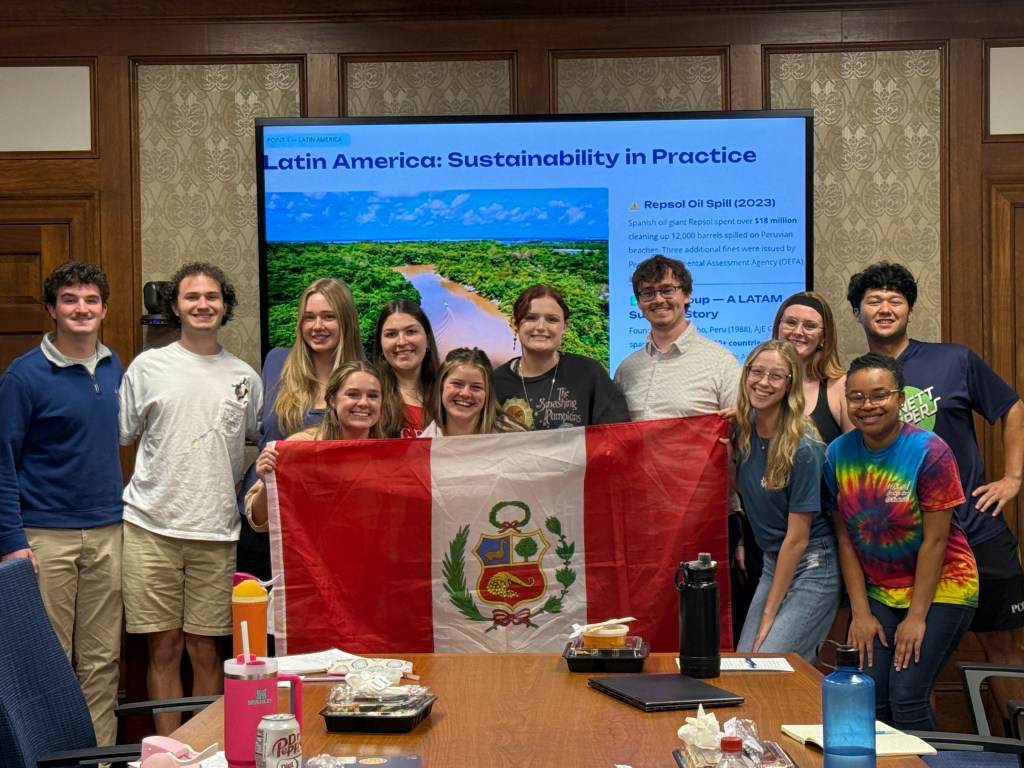
Before our trip, each of us delivered a final presentation connecting a course topic to Peru. Getting to sit through my classmates’ research was one of the most unexpectedly useful parts of this whole pre-departure process. I came out of those presentations knowing things about Peru I would never have thought to look up on my own, and a lot of it is going to change how I see things when we are actually there. Here are three that stuck with me:
Logistics in Peru:
This presentation broke down Peru’s four main modes of logistics: air cargo, roads, rail, and maritime trade. Before this, I had not really thought much about how goods actually move around a country like Peru. It sounds like a simple thing but the infrastructure challenges are serious. The switchback roads, the funding gaps, the way geography makes everything harder than it should be. It gave me a lot more appreciation for how complex it is just to get things from one place to another in a country with that kind of terrain.
I also got my first real introduction to the Callao Port through this presentation, which we will actually be visiting as a site visit while we are there. Going in with that background context is going to make the experience so much more meaningful. I am not just going to be looking at a port anymore. I am going to be looking at it through the lens of everything I now know about Peru’s trade challenges and infrastructure gaps.
Business Organizations in Peru:
This one surprised me the most. I had no idea Peru is currently the fastest-growing economy in Latin America, sitting at a 2.3% growth rate. As an accounting student, the breakdown of business structures was something I could actually connect to what I have learned in class, but seeing it applied to a completely different country and legal system made it click in a new way.
The presenter walked through how different structures affect ownership, taxes, and risk, and then tied each one to a real Peruvian company as an example: local market vendors operating as sole proprietorships, a Peru travel company structured as an LLC, and Alicorp as a corporation. That is exactly the kind of grounding that makes information stick. We also learned about two major government agencies, PromPerú and ProInversión, and the roles they play in driving investment and promoting Peruvian exports. Understanding who the major players are before we get there feels like a real advantage going into our business site visits.
Environmental Stressors:
This one hit differently for me, especially given what I researched for my own presentation. Peru’s environmental challenges are growing and they are largely concentrated in the Amazon region, driven by urban expansion and industrial activity, with mining being one of the biggest contributors. About a third of Peru’s population lives in urban areas, mostly along the coast, but the environmental pressure is being felt most intensely in the inland regions where a lot of that industrial activity is happening.
Mining in particular has caused serious land and water pollution, and the effects on biodiversity and habitat loss are most visible in the Cusco region. Community benefit agreements exist as one way of trying to address that, but climate change is layering even more pressure across all three of Peru’s major geographic regions at the same time. Hearing all of this in the context of a peer presentation made it feel more real than reading about it ever did. These are not just statistics. They are the actual conditions of the places we are about to walk through, and I think that is going to be hard to ignore once we are standing in them.
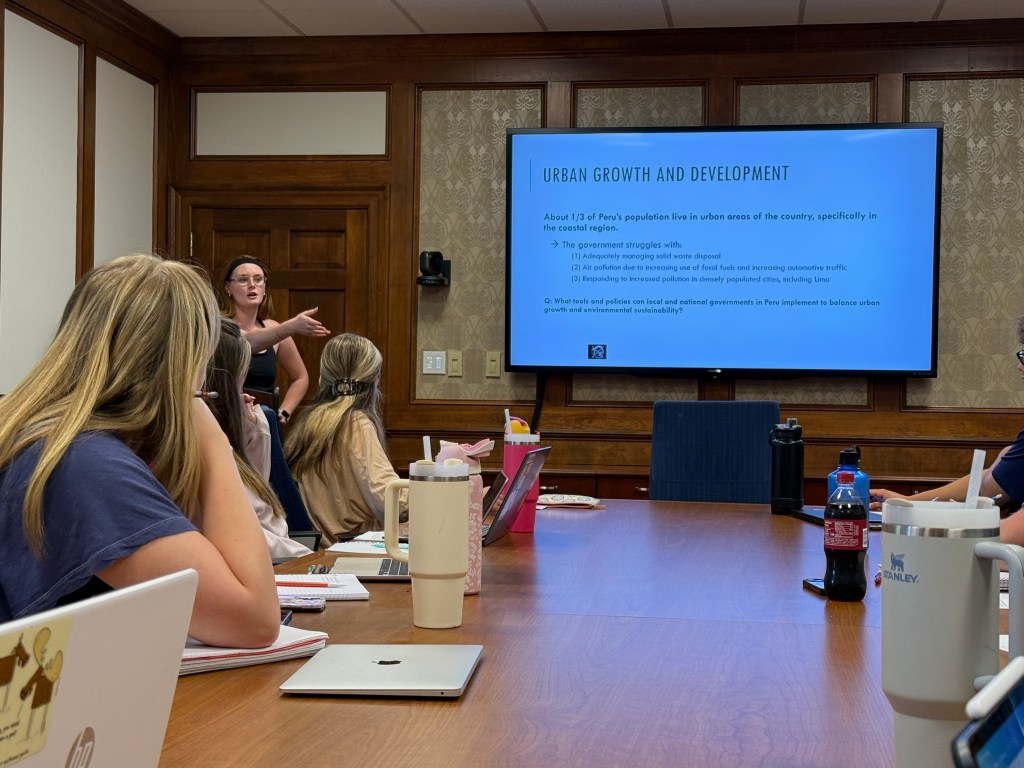
My Presentation: ADR in Peru
I covered Alternative Dispute Resolution in Peru. Specifically, I looked at how Peru handles conflict outside of traditional litigation, from its formal legal framework under Legislative Decree No. 1071 and Law No. 26872 to indigenous dispute resolution and the role of free, prior, and informed consent under ILO Convention 169. I also researched real cases like the Las Bambas mine conflict and dug into institutions like the CCL, AmCham, and MINJUSDH.
Doing the research was one thing. But I genuinely think being in Peru and visiting communities near mining sites and sitting across from business leaders who navigate these tensions daily is going to make everything I researched feel real in a way that a slide deck just cannot. ADR is not just a legal mechanism. It is how people protect their land, their communities, and their relationships with outside actors. I am really eager to see what that actually looks like up close.

Pictured: An aerial view of the Las Bambas copper mine in the Apurímac region of Peru. Source: Peru Reports
Six Weeks Out
Six weeks. That number feels too close and not close enough at the same time.
I am excited and nervous in equal measure. I am excited to explore and genuinely immerse myself in Peruvian culture, to learn from companies that are actively working to protect their land, and to visit the Callao Port and get out on the water in the Amazon. Machu Picchu is one of those places I have seen in videos my whole life thinking I would probably never actually stand there, and now I am going to. That still does not feel totally real to me.
The nervous part is mostly the logistics of moving between Lima, Puerto Maldonado, and the Sacred Valley and just navigating a packed itinerary while being far from home for two full weeks. But honestly, after that climbing tower moment, I feel a little differently about doing hard things. You just start.
I am also really grateful that we had these pre-departure classes. Getting to know this group before we ever board a plane has made a bigger difference than I expected. I know who I am traveling with now and I trust them. That matters a lot more than I thought it would going into this.
Talk soon!

Leave a Reply