Tuesday, June 16 was one of those days where you look back at your itinerary and wonder how you fit all of that into one day. An ancient museum, a recycling facility, and a neighborhood walking tour. Lima really does not slow down.
Museo Larco
I genuinely did not know what to expect walking into Museo Larco, but I left way more fascinated than I thought I would be. The museum holds over 40,000 pieces from the Moche empire alone, and trying to process that much pre-Columbian history in one visit is kind of overwhelming in the best way.
A few things really stuck with me. The metals exhibit explained how ancient Peruvians saw gold and silver not as economic assets but as expressions of supernatural power. Gold represented the sun and masculinity, silver represented the moon and femininity. The ruling class wore these metals in public ceremonies specifically to look godlike, because ordinary people could not understand why they shone so brightly. Honestly, when you think about it through a corporate leadership lens, it is a pretty early example of using optics to consolidate power.
The funerary ritual section was unexpectedly moving. In ancient Peru, death was not an ending but the beginning of a new journey, so the deceased were buried with everything they would need to continue their role in the afterlife. The museum had a scene made from woven dolls showing three women preparing a body for burial, and it was one of those moments where ancient history actually feels human and real.
The textiles exhibit was also really cool. I learned that there are 2,500 different varieties of potatoes that originated in Peru, which sounds completely made up but is not. The guide also mentioned that the driest desert near the Chilean border gets only about 2 inches of rain per year, which is actually why so many textiles survived intact for thousands of years. The coastal pieces did not hold up as well because of the moisture. And fun fact, Peruvian cotton is so high quality that a single coat can cost upward of $17,000. Historically they used vinegar and salt to set the dye, though in earlier times urine was actually the method. Ancient sustainability, I guess.

KPA S.A.C. Recycling Visit
After Museo Larco, we headed to KPA S.A.C. in San Agustin for our corporate visit, and this was a completely different kind of experience. We actually got to walk through the facility where they sort and separate materials for packaging, and I will be honest, it was dirty, it smelled really bad, and it was kind of gross. But that is kind of the whole point. We got to see what recycling actually looks like behind the scenes, not the cleaned-up version you imagine when you toss something in a blue bin.
They separate materials into class 1 cardboard, class 1 paper, mixed materials (which is actually a category unique to this specific facility in Peru), and egg cartons had their own dedicated section. Watching workers physically sort through all of that was a reality check. Recycling is not glamorous. It is labor intensive and it is messy and somebody has to do it.
Beyond the facility itself, the business side of recycling in Peru is complicated. The industry is extremely monopolistic and there is a massive black market for materials and machinery. Baling machines that cost around $300,000 on the formal market can be purchased on the black market for $20,000 to $50,000. Peru also taxes second-hand machines at a higher rate than new ones, which creates this weird incentive structure that pushes companies toward informal markets. Most formal machinery is imported from Europe or the U.S.
The sustainability challenges here do not exist in a vacuum either. They connect to taxation policy, informality, and the absence of real government support for workers. It was a lot to sit with.

Walking Tour of Miraflores
The evening walking tour of Miraflores was the perfect reset after a heavy day. The neighborhood is beautiful in this very polished, coastal way. Ocean views, nice restaurants, parks, and a walkability that felt more European than anything I expected from Lima.
The most interesting thing I learned on the tour was how large the cheese selection was in the market we visited. Also, I was able to see all the different varieties of potatoes Peru has to offer firsthand in the store. It was also my first time visiting a multilevel grocery store. It reminded me about how Lima builds its housing. Families build from the inside out, finishing the interior before the exterior, which is why so many buildings look kind of run down from the street even when they are fully lived in. There is no government support for loans, healthcare, or food assistance, so families save and build incrementally over time. They also keep empty upper floors for their kids and future spouses, which is a really different form of intergenerational wealth that exists completely outside of any formal banking system. The hillside neighborhoods also follow a hierarchical structure where wealthier families live lower and poorer families live higher up.
Oh, and the fridge goes in the living room, not the kitchen. I thought that was so interesting.
Miraflores felt like a city showing off its best side. It is genuinely gorgeous. But after spending the afternoon at KPA and learning everything we did about structural inequality and informal markets, it was hard not to think about what exists just outside that polished frame.

Historic District
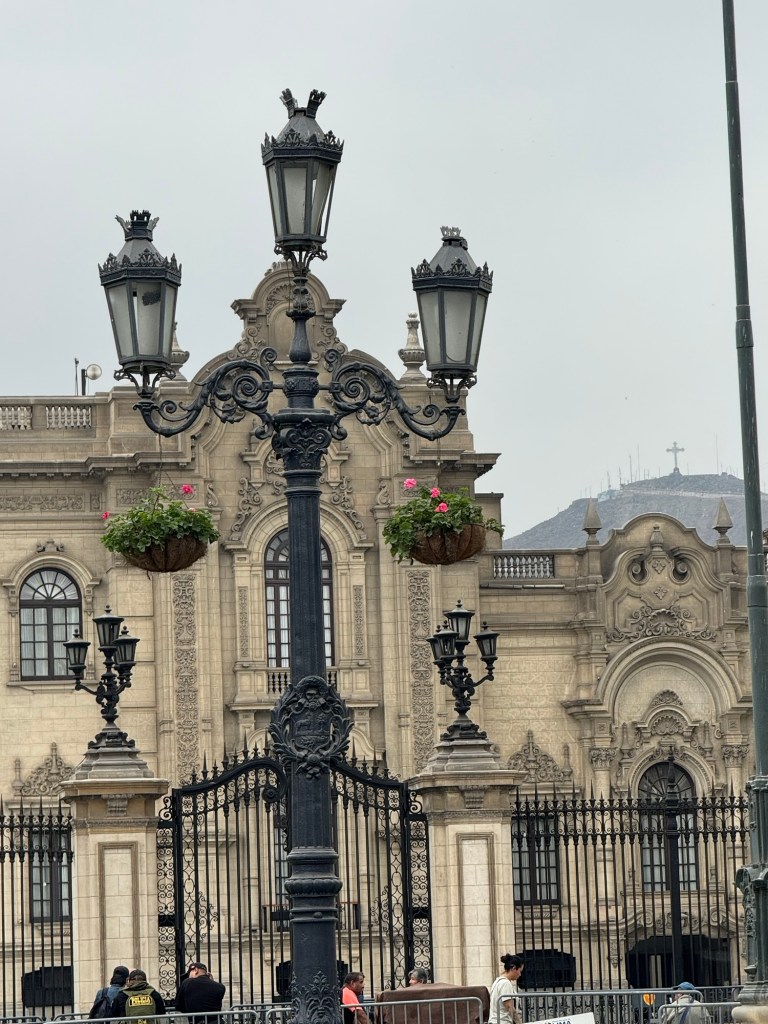
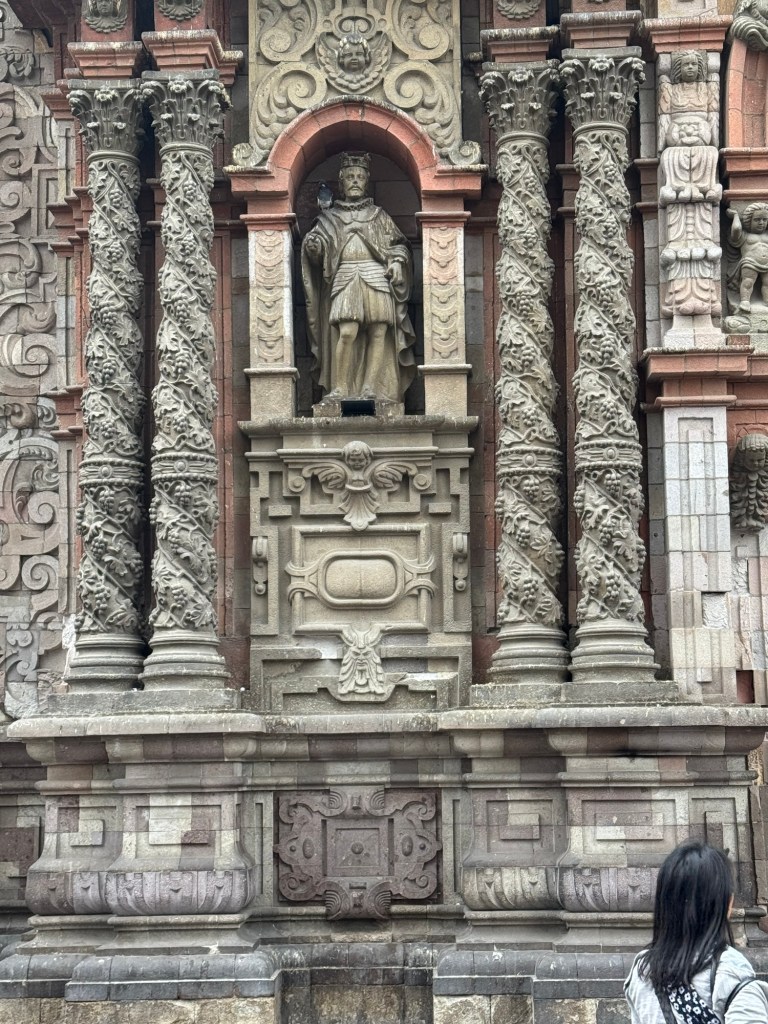
Wednesday started with a walking tour through Lima’s historic district, and honestly it felt like a completely different city compared to Miraflores. The architecture was gorgeous in that old colonial way, and our guide said there are 32 churches in Lima, with one popping up basically every two blocks. Apparently Lima used to be one of the leading silver producers and actually competed with Mexico for that title back in the day, which I had no idea about.
What stood out the most to me was how layered Lima’s population actually is. The Chinese community is the largest immigrant community in the city, then Japanese, then Italian as the third largest. There has also been a huge influx of Venezuelans recently, which our guide tied back to the release of prisoners from jails in Venezuela. That was a lot to sit with, but it gave real context to how Lima’s identity is shaped by waves of migration and not just its colonial backstory.
Random fact I loved: October is “purple month” in Lima because of the Lord of Miracles procession, which is apparently one of the biggest religious processions in the world.
I also thought it was so smart how the city’s churches and buildings are specifically designed to withstand earthquakes since Peru sits right on a major fault line. You can tell in the thick walls and weird structural choices that probably look random if you don’t know why they’re there, but it actually makes a lot of sense once you do.

DP World and the Port of Callao
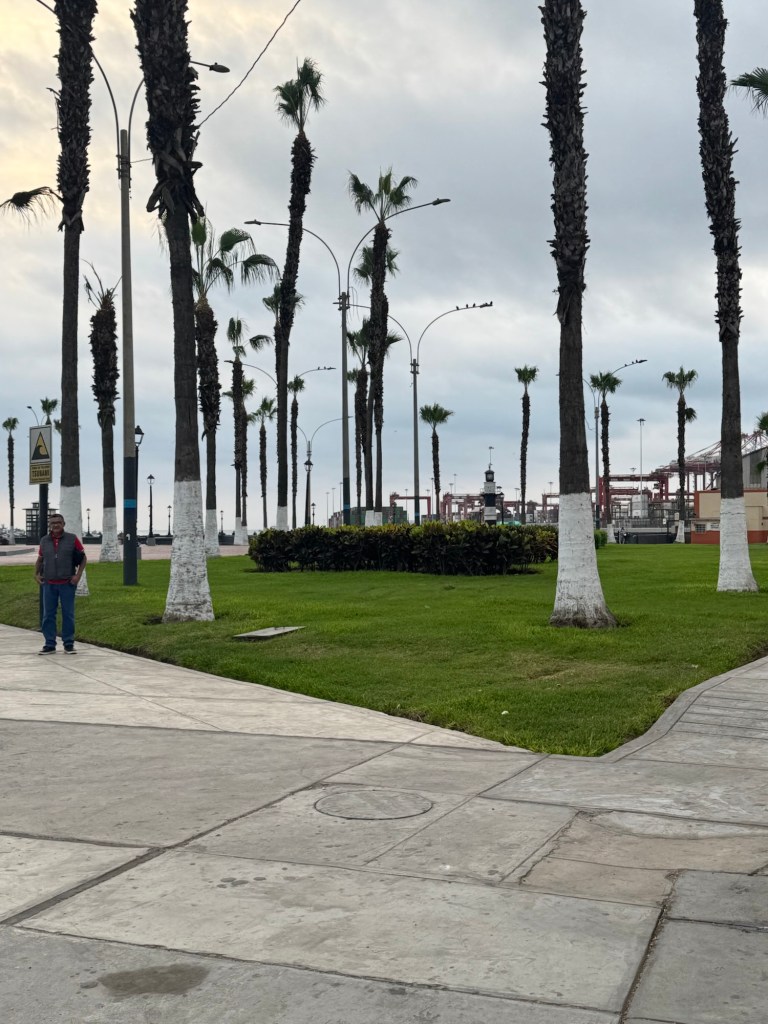
Ok this visit was hands down one of the coolest things we have done so far. The Port of Callao is genuinely massive, and DP World basically explained themselves as the middleman between international trade and Peru, making sure goods get in and out efficiently. After seeing the operation in person, that is not even an exaggeration.
The numbers alone were insane. Container movement at DP World Callao grew 121 percent from 2005 to 2024, and volume jumped another 19 percent from 2023 to 2024, then 7 percent more into 2025. Looking specifically at the South Pier, productivity went from 10 to 11 containers per hour back in 2005 to 28 containers per hour in 2025 after DP World invested $1 billion. That kind of growth made the whole “global supply chain” concept we talk about in class feel a lot less abstract and a lot more real.
Sustainability-wise, I was honestly impressed. About 80 percent of their vehicles are electric, including 36 out of 77 internal trucks. They have 20 electric chargers throughout the port and charge vehicles during lunch breaks, where 45 minutes of charging gives about 10 hours of operation, which is wild. There are also 10 electric, 10 diesel, and 10 hybrid cranes in the yard zone, and they are working on converting their currently manual cranes to remote operation, which they said would make crane operations about 25 percent more efficient and save roughly a minute per movement just from cutting down unnecessary motion.
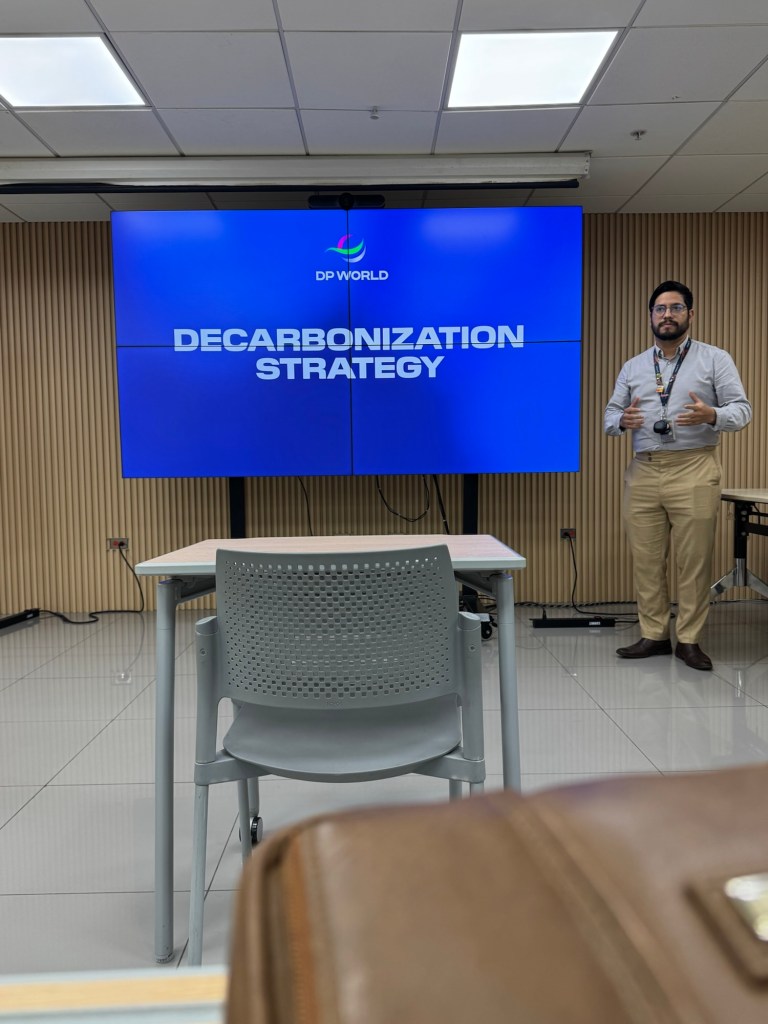
They also walked us through their full decarbonization roadmap with an SBTi-verified goal of cutting carbon 42 percent by 2030 using 2022 as the baseline, broken down across Scope 1, 2, and 3 emissions, working toward net zero by 2050. What I respected was that they did not try to make it sound purely selfless. Their slide literally broke their reasoning down into avoiding risk, regulatory compliance, customers, investors, reputation, and revenue, plus what they called the “good cause” of fighting climate change. It felt way more honest than a lot of the corporate sustainability messaging we have picked apart in class.
As far as evidence of those commitments actually showing up in practice, the port itself was noticeably clean, container stacking is capped at 6 high for safety, there is a dedicated sanitary section, and the gating area has 8 fully automated lanes. They have over 1,000 total workers with about 250 per shift, an 8 hour workday across 6 days a week for operators (5 days for admin staff), and a full month of vacation, which says a lot when you compare it to what we learned about labor conditions and the informal economy at KPA.
Where I think the gap still exists is automation. Most cranes are still manually operated, and the shift toward remote and automated systems is happening in phases through 2026 and 2028, not all at once. So while the public commitments and the billion dollar investment are clearly real, the day-to-day reality is still very much a work in progress.
Geography, History, and Global Commerce
Honestly, looking back at the whole week, Lima might be one of the clearest examples I have seen of how geography and history shape a country’s place in global commerce. Callao’s deep water access made it valuable for trade centuries ago, and that is exactly why DP World has poured a billion dollars into modernizing it now. The colonial history we saw downtown, the waves of immigration that shaped who lives in Lima today, and the scale of imports coming in from China all trace back to the same thing: Lima’s spot on the Pacific has always made it a gateway, first for colonial silver, now for shipping containers.
What I keep coming back to is that you cannot really separate sustainability in Peru from its history or its inequality. DP World’s whole decarbonization roadmap exists in the same country where KPA is dealing with black market recycling machinery and basically zero government support for loans. Big corporate sustainability commitments and small-scale informal economic survival are happening at the exact same time, in the exact same city, and Lima is sitting right in the middle of both.

Leave a comment